


Expressing appreciation is one of the strongest parts of human communication, and using other ways to say I am proud of you helps you sound more natural, more fluent, and more emotionally intelligent in different situations
. Instead of repeating the same phrase again and again, learning other ways to say I am proud of you allows you to adjust your tone depending on whether you are speaking to friends, family, teachers, or colleagues.
You can also read: 26+ Other Ways to Say “This Shows” in an Essay (Formal, Informal & Professional Alternatives 2026 updated)
In modern English, repetition is often avoided in both spoken and written communication. That is why other ways to say I am proud of you are widely used in workplaces, academic feedback, emails, interviews, and social conversations.
These alternatives help you express appreciation in a more precise and meaningful way while maintaining an appropriate tone.
This guide provides detailed other ways to say I am proud of you with meanings, usage, grammar notes, examples, and context so you can confidently use them in real-life communication.
What Does “I Am Proud of You” Mean?
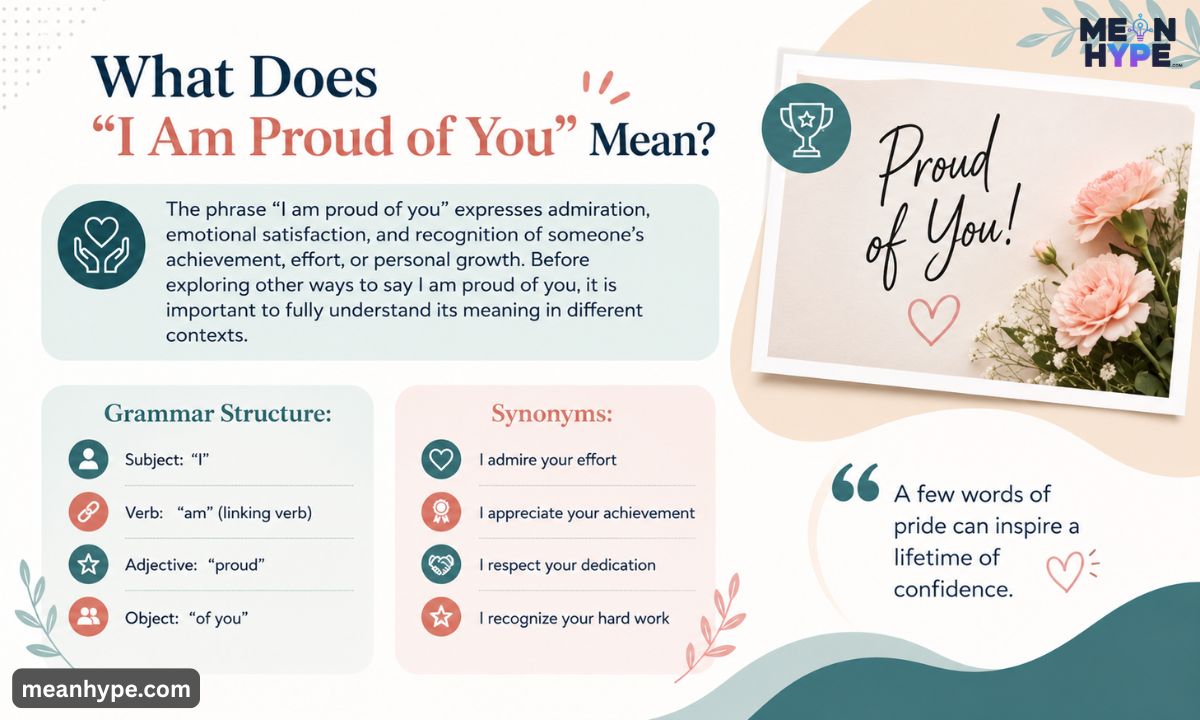
The phrase “I am proud of you” expresses admiration, emotional satisfaction, and recognition of someone’s achievement, effort, or personal growth. Before exploring other ways to say I am proud of you, it is important to fully understand its meaning in different contexts.
Definition:
The expression “I am proud of you” is used to communicate a deep sense of appreciation, approval, and emotional satisfaction regarding someone’s behavior, progress, or accomplishments.
It reflects a positive acknowledgment of effort, personal development, or success and serves as a form of encouragement that motivates continued growth and confidence 😊
Grammar Structure:
The sentence follows a simple structure
- Subject: “I”
- Verb: “am” (linking verb)
- Adjective: “proud”
- Object: “of you”
Synonyms:
- I admire your effort
- I appreciate your achievement
- I respect your dedication
- I recognize your hard work
Opposite Expressions:
- I am disappointed in your performance
- I am unhappy with your results
- I expected better from you
Example Sentences:
- I am proud of you for passing your exams with excellent marks.
- I am proud of you for staying consistent with your work.
Understanding this meaning helps you choose the right other ways to say I am proud of you depending on the emotional or professional context.
When to Use “I Am Proud of You”
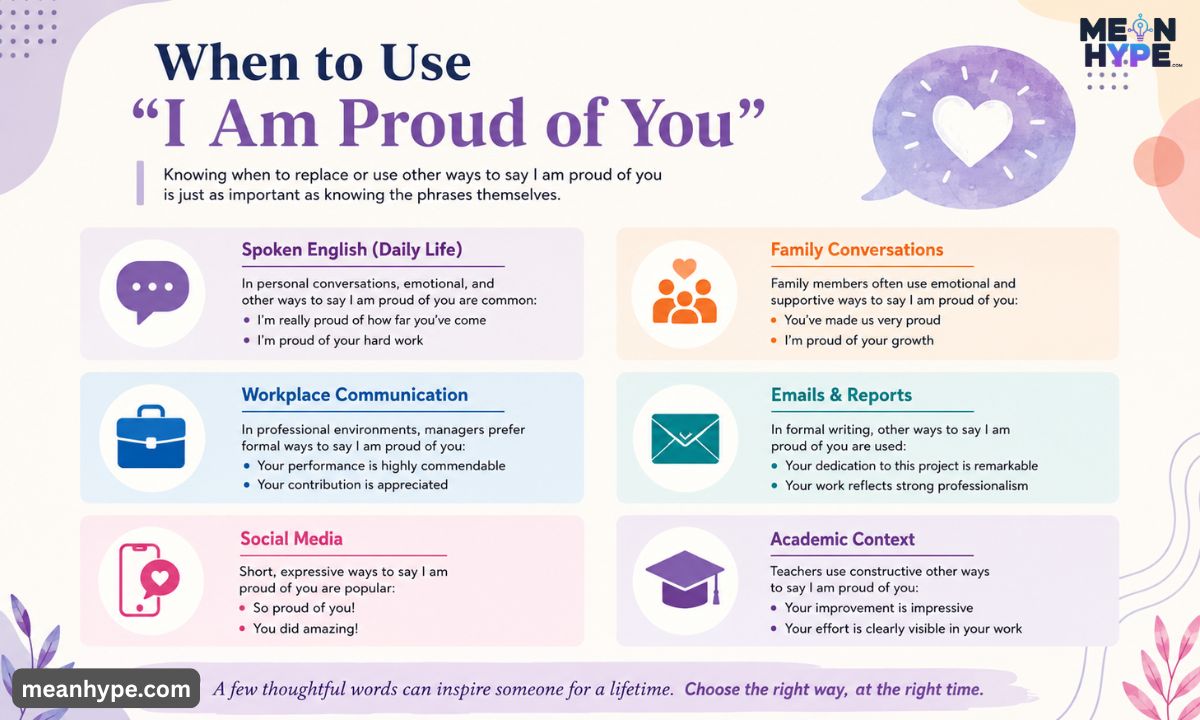
Knowing when to replace or use other ways to say I am proud of you is just as important as knowing the phrases themselves.
Spoken English (Daily Life)
In personal conversations, emotional, and other ways to say I am proud of you are common:
- I’m really proud of how far you’ve come
- I’m proud of your hard work
Family Conversations
Family members often use emotional and supportive ways to say I am proud of you:
- You’ve made us very proud
- I’m proud of your growth
Workplace Communication
In professional environments, managers prefer formal ways to say I am proud of you:
- Your performance is highly commendable
- Your contribution is appreciated
Emails & Reports
In formal writing, other ways to say I am proud of you are used:
- Your dedication to this project is remarkable
- Your work reflects strong professionalism
Social Media
Short, expressive ways to say I am proud of you are popular:
- So proud of you!
- You did amazing!
Academic Context
Teachers use constructive other ways to say I am proud of you:
- Your improvement is impressive
- Your effort is clearly visible in your work
Is “I Am Proud of You” Polite or Professional?
The phrase is polite and emotionally positive, but its professionalism depends on context. This is why other ways to say I am proud of you are important in communication.
Tone Analysis:
- Polite: A respectful tone that shows appreciation, recognition, and basic admiration without being overly emotional or intense.
- Neutral: A balanced and practical tone that works in a wide range of situations. It is neither too formal nor too emotional.
- Strong: A highly expressive tone that conveys deep appreciation, emotional affirmation, and strong recognition of achievement.
- Soft: A gentle and supportive tone used to encourage or comfort someone in a calm and caring way. It is especially useful in sensitive situations.
Formal vs Informal Use:
- Formal: Best suited for professional, academic, and workplace environments where structured and respectful language is required. It emphasizes results, performance, and achievement in a polished way.
- Informal: Used in friendly, personal, or family conversations where emotional expression is more natural and relaxed. It often feels warm, direct, and encouraging.
- Etiquette Tip: In professional or corporate communication, avoid using highly emotional phrases like “I am proud of you” when you are not personally close to the recipient.
Example:
Instead of saying “I am proud of you,” a manager may say:
- Your performance has been outstanding this quarter
This shows how other ways to say I am proud of you improve professional communication.
Pros & Cons of Using “I Am Proud of You”
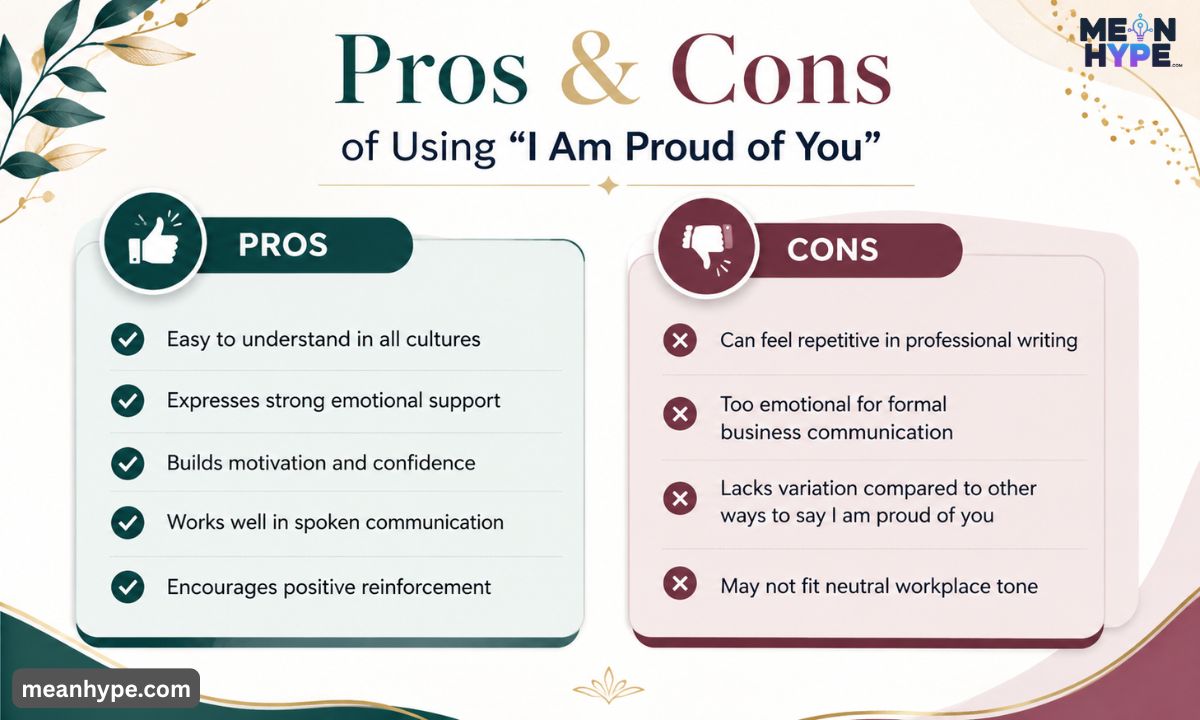
✔ Pros
- Easy to understand in all cultures
- Expresses strong emotional support
- Builds motivation and confidence
- Works well in spoken communication
- Encourages positive reinforcement
✘ Cons
- Can feel repetitive in professional writing
- Too emotional for formal business communication
- Lacks variation compared to other ways to say I am proud of you
- May not fit neutral workplace tone
Using other ways to say I am proud of you helps solve these limitations and improves communication quality.
Quick Alternatives List (One-Line Phrases)
These quick other ways to say I am proud of you can be used in daily communication:
- Well done
- Great job
- Excellent work
- Impressive effort
- You nailed it
- Kudos to you
- Outstanding performance
- You should be proud of yourself
- Truly impressive
- Exceptional achievement
- Fantastic work
- Brilliant effort
- Strong performance
- Remarkable work
- Keep it up
These are commonly used other ways to say I am proud of you across informal and professional situations.
12 Alternatives to “I Am Proud of You”
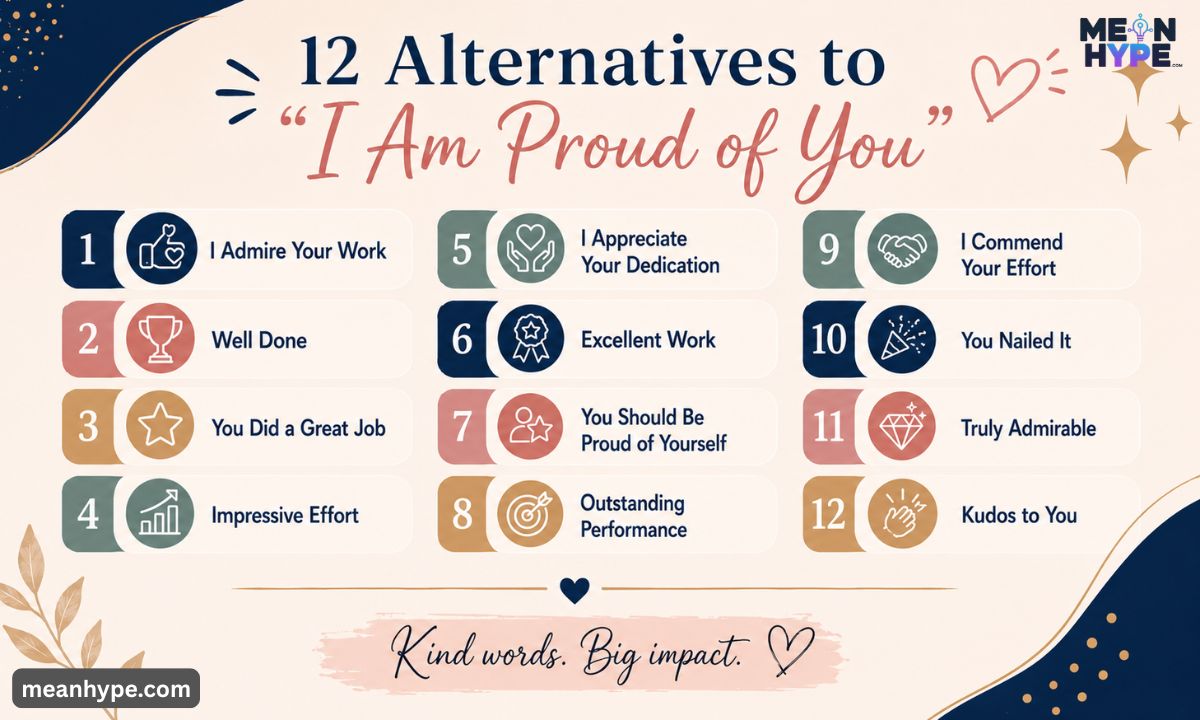
Below are detailed other ways to say I am proud of you with explanations and usage.
1. I Admire Your Work
A formal and respectful expression used in professional environments.
- Meaning: Shows genuine respect and appreciation for someone’s effort, skill, or achievement.
- Explanation: Focuses more on valuing the quality of work rather than emotional praise, making it suitable for professional recognition.
- Grammar Note: Verb phrase
- Example Sentence: I truly admire your work on this project report.
- Best Use: Formal, Workplace, Email
- Worst Use: Casual conversations with close friends (may feel too serious)
- Tone: Formal / Neutral
- Level: Intermediate
- Similarity Score: 8/10
- Replaceability Tip: Best used when you want professional appreciation without emotional attachment.
This is one of the strongest ways to say I am proud of you in corporate settings.
2. Well Done
A simple and widely used expression in everyday communication.
- Meaning: A quick and simple expression used to praise someone for completing a task successfully.
- Explanation: Commonly used in spoken English to show immediate approval or satisfaction.
- Grammar Note: Interjection
- Example Sentence: Well done on completing your assignment before the deadline!
- Best Use: Informal, Classroom, Social interactions
- Worst Use: Highly formal business communication (may sound too basic)
- Tone: Friendly / Neutral
- Level: Beginner
- Similarity Score: 9/10
- Replaceability Tip: Ideal for short and instant appreciation in daily conversation.
It is one of the easiest ways to say I am proud of you.
3. You Did a Great Job
A clear and natural way to express appreciation.
- Meaning: Directly praises someone’s performance or effort clearly and encouragingly.
- Explanation: A widely used phrase that is easy to understand and suitable for many contexts.
- Grammar Note: Declarative sentence
- Example Sentence: You did a great job managing the team during the event.
- Best Use: Workplace, Informal chats, Emails
- Worst Use: Formal academic writing (may feel too casual)
- Tone: Friendly / Neutral
- Level: Beginner
- Similarity Score: 10/10
- Replaceability Tip: Perfect for everyday encouragement and feedback.
Common in both casual and professional, other ways to say I am proud of you.
4. Impressive Effort
Focuses more on effort than results.
- Meaning: Recognizes the hard work and dedication someone has put into a task rather than just the final result.
- Explanation: Highlights commitment, focus, and persistence in a professional tone.
- Grammar Note: Noun phrase
- Example Sentence: Your effort on this presentation shows impressive dedication and focus.
- Best Use: Workplace, Academic, Reports
- Worst Use: Casual texting (may feel too formal)
- Tone: Professional / Formal
- Level: Intermediate
- Similarity Score: 8/10
- Replaceability Tip: Best when you want to praise effort instead of outcome.
A useful option in other ways to say I am proud of you for workplace feedback.
5. I Appreciate Your Dedication
A formal expression used in professional communication.
- Meaning: Expresses gratitude and respect for someone’s consistent effort and commitment.
- Explanation: Commonly used in professional environments to acknowledge reliability and hard work.
- Grammar Note: Verb phrase
- Example Sentence: I appreciate your dedication to completing this task on time.
- Best Use: Workplace, Emails, Formal discussions
- Worst Use: Casual friendly chats (may sound too serious)
- Tone: Formal / Neutral
- Level: Intermediate
- Similarity Score: 7/10
- Replaceability Tip: Use when acknowledging long-term effort or responsibility.
Frequently used in other ways to say I am proud of you in emails.
6. Excellent Work
A direct and strong expression of approval.
- Meaning: A strong and clear compliment for high-quality performance or results.
- Explanation: Often used in professional settings to recognize accuracy, skill, or achievement.
- Grammar Note: Adjective + noun
- Example Sentence: Excellent work on preparing the financial report.
- Best Use: Workplace, Email, Formal feedback
- Worst Use: Casual conversations (may sound stiff)
- Tone: Formal / Neutral
- Level: Beginner
- Similarity Score: 9/10
- Replaceability Tip: Best for direct and professional praise.
One of the most common other ways to say I am proud of you in offices.
7. You Should Be Proud of Yourself
Encourages self-recognition and motivation.
- Meaning: Encourages self-recognition and personal appreciation for one’s achievement.
- Explanation: Focuses on building confidence and emotional motivation rather than external praise.
- Grammar Note: Modal + verb phrase
- Example Sentence: You should be proud of yourself for overcoming all these challenges.
- Best Use: Informal, Mentoring, Friendly conversations
- Worst Use: Strict corporate emails (may feel too personal)
- Tone: Friendly / Supportive
- Level: Intermediate
- Similarity Score: 9/10
- Replaceability Tip: Great for emotional encouragement and motivation.
A motivational version of other ways to say I am proud of you.
8. Outstanding Performance
Used in evaluations and formal feedback.
- Meaning: A formal way to recognize exceptional results or achievements.
- Explanation: Commonly used in evaluations, reports, and professional recognition.
- Grammar Note: Noun phrase
- Example Sentence: Your outstanding performance this quarter exceeded expectations.
- Best Use: Workplace, Corporate feedback, Academic results
- Worst Use: Casual chatting (too formal)
- Tone: Formal / Professional
- Level: Advanced
- Similarity Score: 8/10
- Replaceability Tip: Best for formal recognition or appraisal.
Common in corporate, other ways to say I am proud of you.
9. I Commend Your Effort
A highly formal expression used in academic and professional writing.
- Meaning: A respectful and formal acknowledgment of someone’s hard work.
- Explanation: Often used in official communication or structured feedback.
- Grammar Note: Verb phrase
- Example Sentence: I commend your effort in completing this challenging assignment.
- Best Use: Formal, Academic, Workplace
- Worst Use: Casual texting (sounds stiff)
- Tone: Formal / Neutral
- Level: Advanced
- Similarity Score: 7/10
- Replaceability Tip: Suitable for official praise or written evaluations.
A strong formal alternative in other ways to say I am proud of you.
10. You Nailed It
A casual and energetic expression.
- Meaning: Informal praise for completing something perfectly or successfully.
- Explanation: A casual and enthusiastic expression used among peers or friends.
- Grammar Note: Idiomatic expression
- Example Sentence: You nailed it during your presentation today!
- Best Use: Informal, Social media, Friends
- Worst Use: Corporate emails (too casual)
- Tone: Friendly / Enthusiastic
- Level: Intermediate
- Similarity Score: 8/10
- Replaceability Tip: Best for energetic and informal appreciation.
Popular among younger audiences are other ways to say I am proud of you.
11. Truly Admirable
Used for respectful and formal appreciation.
- Meaning: Expresses deep respect for someone’s character, effort, or achievement.
- Explanation: Slightly formal and often used in written or professional communication.
- Grammar Note: Adjective phrase
- Example Sentence: Your commitment to helping others is truly admirable.
- Best Use: Formal, Academic, Professional writing
- Worst Use: Casual conversation (may feel stiff)
- Tone: Formal / Respectful
- Level: Advanced
- Similarity Score: 7/10
- Replaceability Tip: Use when praising values or character.
A refined option in other ways to say I am proud of you.
12. Kudos to You
A modern and casual expression.
- Meaning: A casual expression used to recognize and celebrate someone’s achievement.
- Explanation: Friendly and modern phrase often used in informal communication.
- Grammar Note: Interjection / Noun phrase
- Example Sentence: Kudos to you for finishing the task ahead of time!
- Best Use: Social media, Informal chats, Friendly emails
- Worst Use: Formal corporate communication (too casual)
- Tone: Casual / Friendly
- Level: Intermediate
- Similarity Score: 8/10
- Replaceability Tip: Best for quick appreciation and public praise
.
One of the most popular other ways to say I am proud of you in social media.
Mini Dialogue Examples
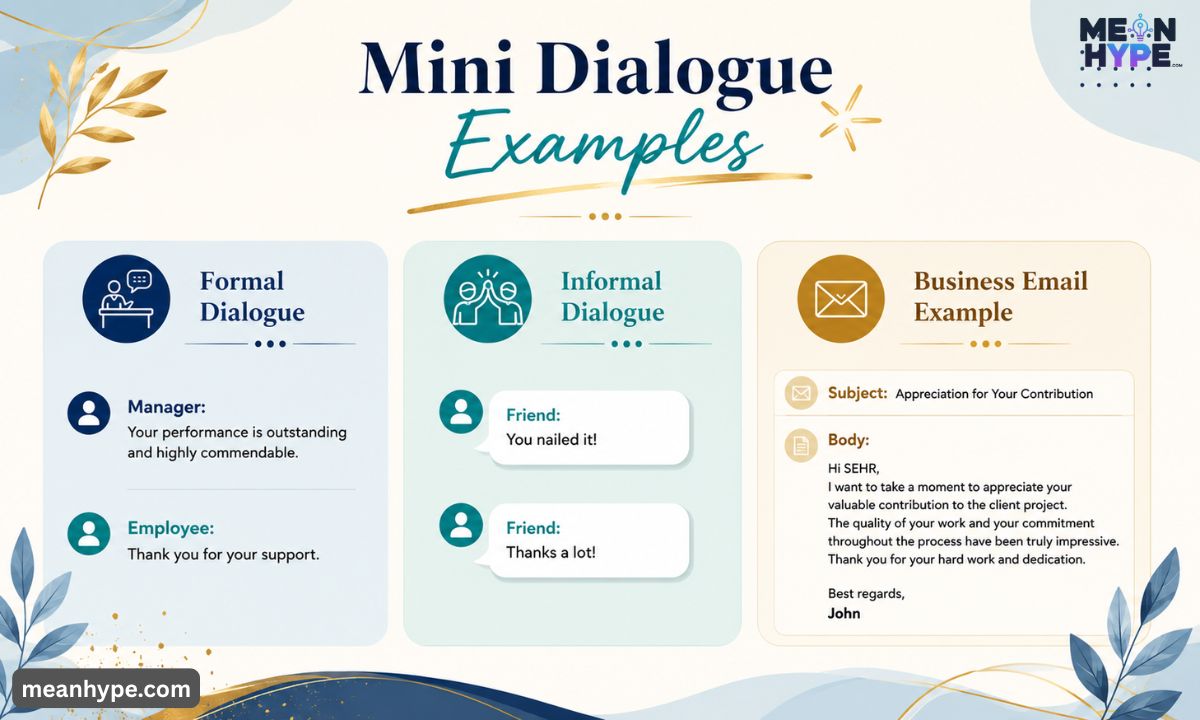
Formal Dialogue
- Manager: Your performance is outstanding and highly commendable
- .Employee: Thank you for your support.
Informal Dialogue
- Friend: You nailed it!
- Friend: Thanks a lot!
Business Email Example
- Subject: Appreciation for Your Contribution
- Body: Hi SEHR, I want to take a moment to appreciate your valuable contribution to the client project. The quality of your work and your commitment throughout the process have been truly impressive. Thank you for your hard work and dedication. Best regards, John
These examples show practical use of other ways to say I am proud of you.
Mistakes to Avoid
When using other ways to say I am proud of you, avoid:
- Using casual phrases in formal emails
- Repeating the same expression too often
- Giving vague praise without detail
- Ignoring the audience and tone
- Mixing emotional and professional language incorrectly
Proper use of other ways to say I am proud of you improves clarity and professionalism.
Cultural & Tone Tips
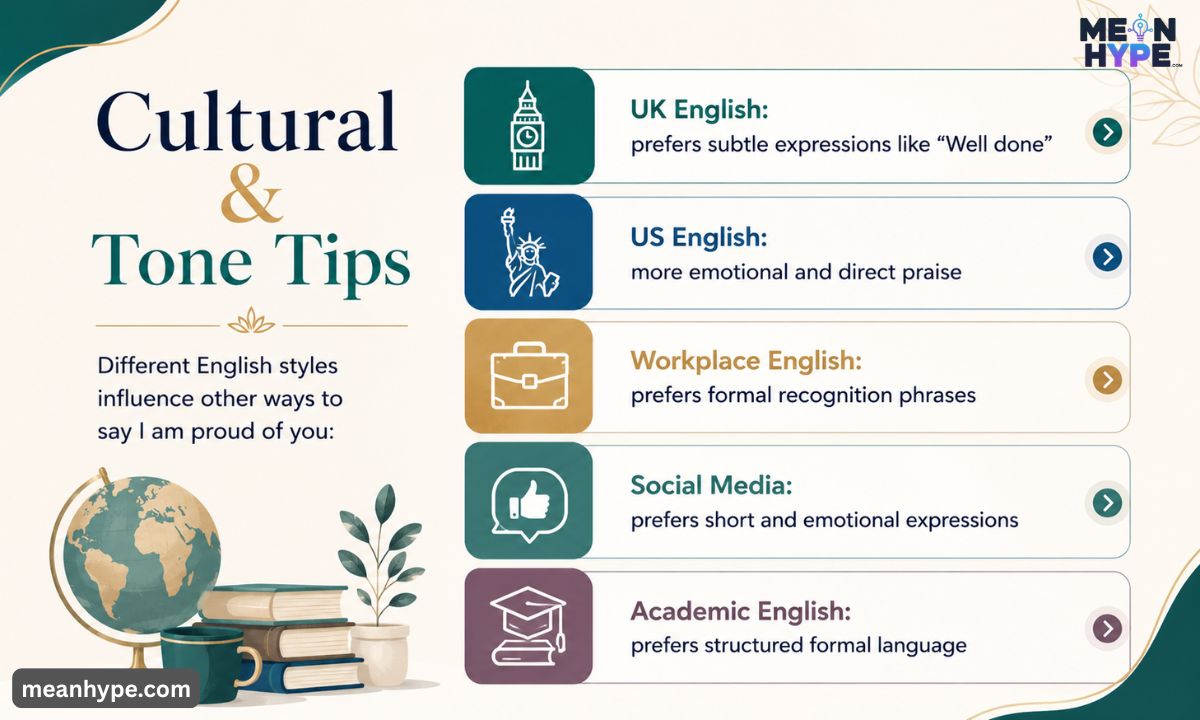
Different English styles influence other ways to say I am proud of you:
- UK English: prefers subtle expressions like “Well done”
- US English: more emotional and direct praise
- Workplace English: prefers formal recognition phrases
- Social Media: prefers short and emotional expressions
- Academic English: prefers structured formal language
These variations help you select better ways to say I am proud of you.
Comparison Table
| Phrase | Tone | Best Use |
| I admire your work | Formal | Workplace |
| Well done | Casual | Daily use |
| You did a great job | Neutral | General communication |
| Impressive effort | Professional | Reports |
| You nailed it | Informal | Friends |
| Kudos to you | Casual | Social media |
| Outstanding performance | Formal | Evaluation |
This table summarizes other ways to say I am proud of you effectively.
FAQs
What are other ways to say I am proud of you?
They are alternative phrases used to express appreciation, recognition, and encouragement.
Can I use them in emails?
Yes, especially formal other ways to say I am proud of you, like “Excellent work” or “I commend your effort.”
Which is most professional?
“Outstanding performance” and “I admire your work.”
Are they good for friends?
Yes, informal other ways to say I am proud of you, like “You nailed it” are perfect.
Why should I use them?
To improve communication variety, tone control, and professionalism.
Conclusion
Learning other ways to say I am proud of you is essential for improving English communication in modern settings. Whether you are speaking casually, writing emails, or giving professional feedback, using other ways to say I am proud of you helps you sound more natural, fluent, and expressive.
By practicing these other ways to say I am proud of you, you can enhance your communication skills, build stronger relationships, and avoid repetitive language in everyday speech and writing.

Ston is the founder and author of MeanHype, a website dedicated to explaining meanings, definitions, slang terms, phrases, abbreviations, and modern internet language in a simple and easy-to-understand way. With a passion for language and digital culture, Ston creates helpful content that makes complex or trending terms clear for readers around the world.