


The phrase “this shows” is widely used in essays, reports, emails, and everyday communication to present evidence, explain results, or support an argument. It is simple, clear, and effective for connecting ideas logically.
In fact, many students rely heavily on other ways to say this shows in an essay to strengthen academic writing and avoid repetition.
However, overusing “this shows” can make writing feel repetitive and less engaging, especially in academic essays where variety and precision are important. That is why learning other ways to say this shows in an essay helps improve sentence flow and overall writing quality.
Using other ways to say this shows in an essay allows writers to adjust tone based on context—formal, neutral, or informal. It also improves clarity and makes arguments more persuasive.
In academic writing, other ways to say this shows in an essay are essential for demonstrating strong vocabulary and analytical skills.
You can also read: WTM Mean in Text: The Real Meaning Explained (2026)
For example, instead of repeating this shows, you can use more advanced expressions like this demonstrates or this illustrates. These alternatives are commonly used in other ways to say this shows in an essay techniques to improve writing style.
By mastering other ways to say this shows in an essay, students can make their essays more dynamic, professional, and impactful.
What Does “This Shows” Mean?
Definition:
The phrase “this shows” is used when something provides evidence, explanation, or proof of a point. It helps the writer connect facts, examples, or data to a conclusion.
Understanding other ways to say this shows in an essay begins with understanding its meaning in context.
Grammar Form:
- Verb phrase
- Present tense structure: shows
- Usually followed by a supporting clause or explanation
Synonyms:
- Demonstrates (formal)
- Indicates (neutral)
- Reveals (formal)
- Highlights (neutral)
- Suggests (polite/soft tone)
Opposites:
- Hides
- Conceals
- Misrepresents
Example Sentences:
- The results show a clear performance improvement.
- Her reaction shows that she was not expecting the outcome.
- The data shows a strong link between study time and grades.
These examples are often rewritten using other ways to say this shows in an essay for better academic quality.
When to Use “This Shows”
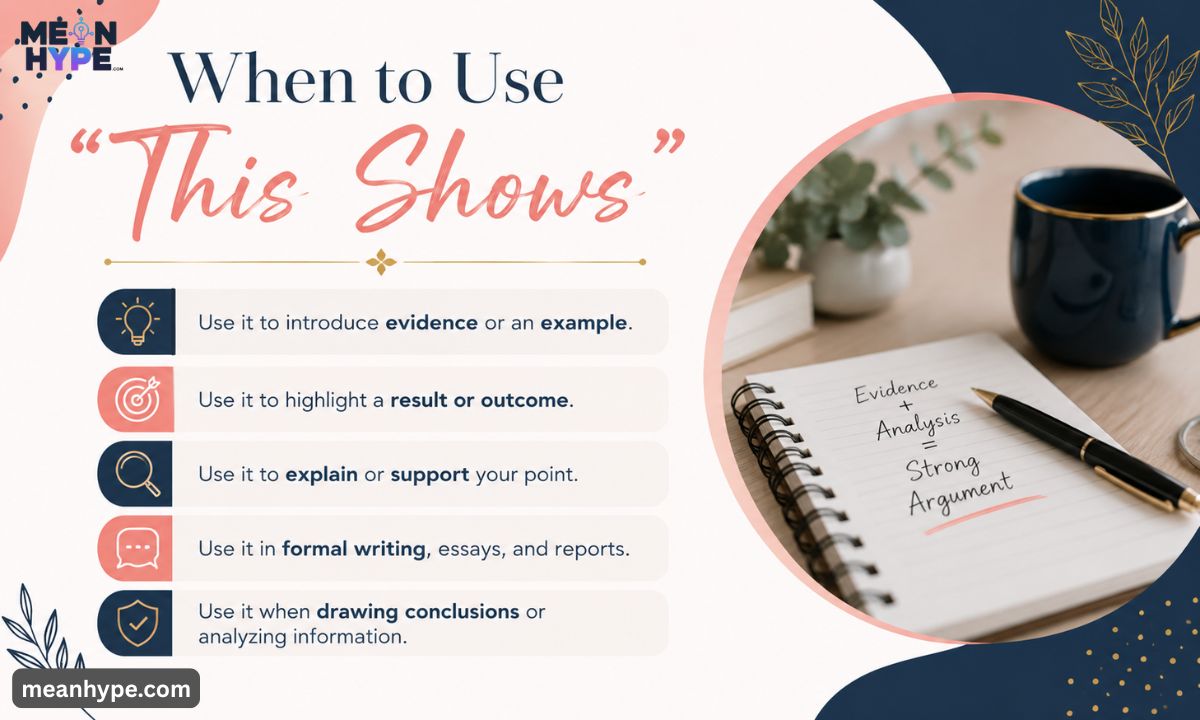
Spoken English:
Used in daily conversations to explain or support ideas simply.
- “This shows why practice is important for success.”
Business English:
Used in reports, analysis, and decision-making contexts.
- This shows a decline in customer satisfaction over the last quarter.”
Emails / Messages:
Used to explain results or updates clearly in written communication.
- “This shows that customers prefer faster support channels.”
Social Media:
Used in captions or posts to explain visuals or experiences.
- “This shows how beautiful teamwork can be ❤️”
Academic Writing:
Commonly used in essays, research papers, and assignments.
- “This shows a significant relationship between nutrition and mental health.”
Professional Meetings:
Used when presenting data or findings.
- “This shows that our new strategy is improving overall performance.”
Is “This Shows” Polite or Professional?
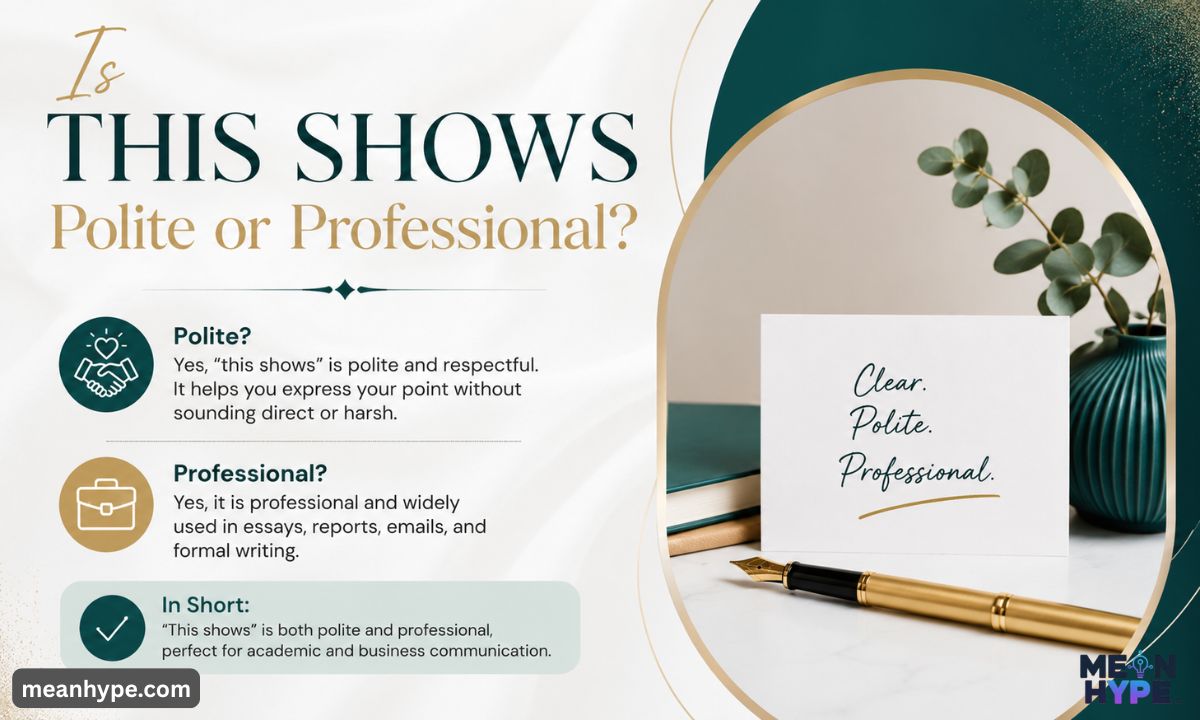
Tone:
- Neutral to semi-formal
Politeness Level:
- Generally polite and acceptable in most contexts
Formal vs Informal Usage:
- Formal: Acceptable but often replaced with stronger academic alternatives
- Informal: Common in daily speech and casual writing
Etiquette Tip:
In academic or professional writing, avoid overusing it. Instead, use other ways to say this shows in an essay, use stronger academic verbs like “demonstrates” or “illustrates” to improve writing quality and sophistication.
Pros & Cons of Using “This Shows”
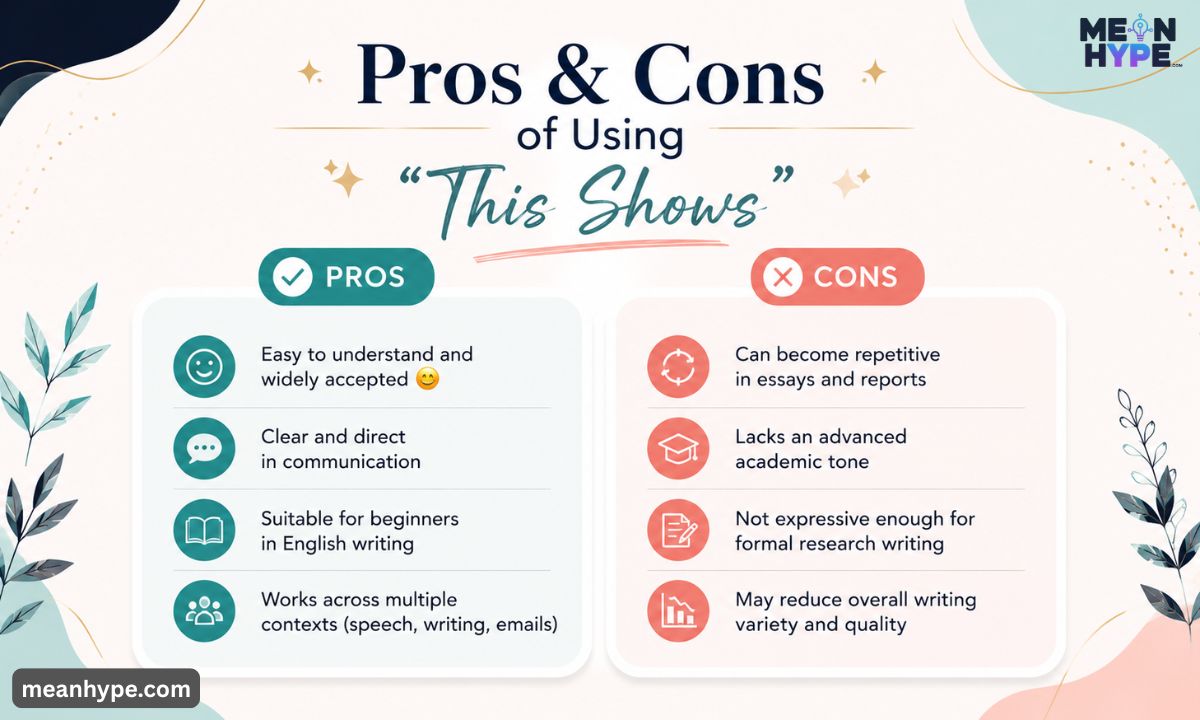
✔ Pros:
- Easy to understand and widely accepted 😊
- Clear and direct in communication
- Suitable for beginners in English writing
- Works across multiple contexts (speech, writing, emails)
✘ Cons:
- Can become repetitive in essays and reports
- Lacks an advanced academic tone
- Not expressive enough for formal research writing
- May reduce overall writing variety and quality
Many of these issues are solved by using other ways to say this shows in an essay effectively.
Quick Alternatives List
- Demonstrates
- Indicates
- Highlights
- Reveals
- Reflects
- Suggests
- Proves
- Confirms
- Points out
- Illustrates
- Signals
- Makes clear
- Validates
- Establishes
- Emphasizes
- Corroborates
All of these are commonly used as other ways to say this shows in an essay in academic writing
12 Expanded Alternatives to “This Shows”
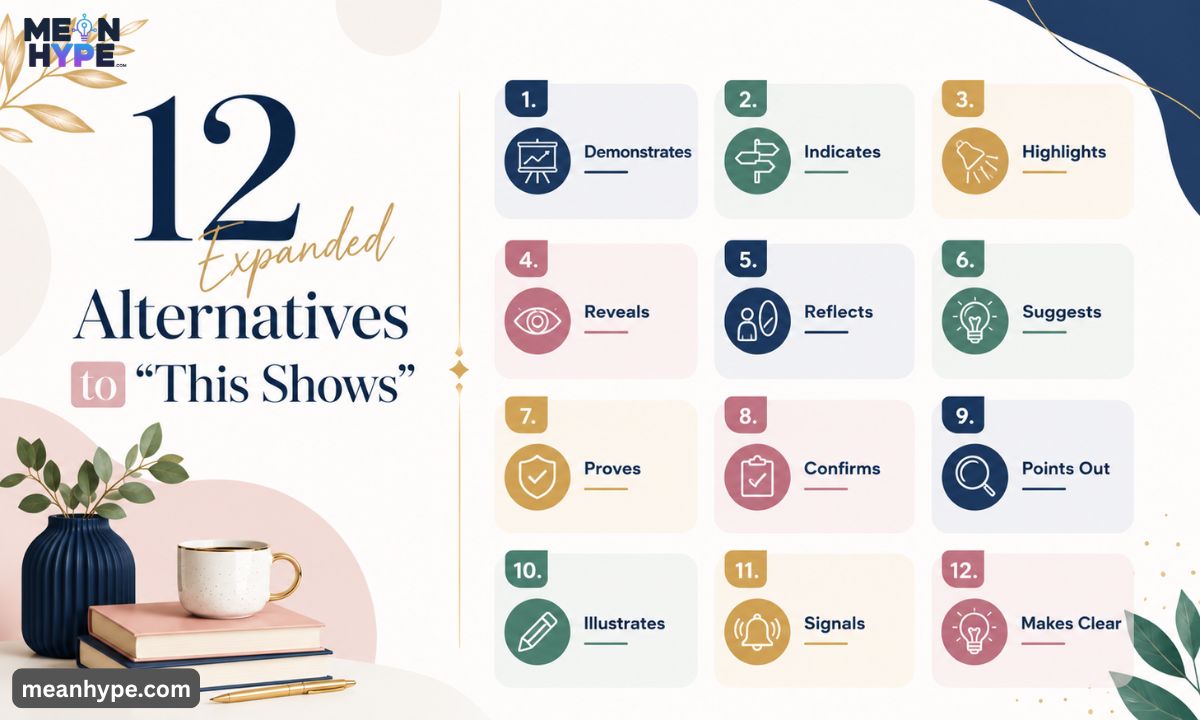
1. Demonstrates
- Meaning: Clearly proves or illustrates a point.
- Explanation: Strong formal expression is often used in academic and professional writing.
- Grammar: Verb (formal usage)
- Example: The survey demonstrates a strong preference for online learning.
- Best Use: Academic writing, reports, workplace documents
- Worst Use: Casual texting or informal chat
- Tone: Formal / Professional
- Level: Intermediate
- Similarity Score: 9/10
- Replaceability Tip: Best when you need a strong academic evidence presentation 📘
2. Indicates
- Meaning: Suggests or points toward a fact or trend.
- Explanation: Neutral and widely used in both formal and semi-formal contexts.
- Grammar: Verb (neutral tone)
- Example: The data indicates an increase in productivity.
- Best Use: Academic writing, emails, reports
- Worst Use: Very casual conversations
- Tone: Neutral
- Level: Beginner / Intermediate
- Similarity Score: 8/10
- Replaceability Tip: Use when you want a soft, non-absolute statement 📊
3. Highlights
- Meaning: Brings attention to an important point.
- Explanation: Emphasizes key information clearly and effectively.
- Grammar: Verb
- Example: The case study highlights major challenges faced by startups.
- Best Use: Business reports, presentations, essays
- Worst Use: Highly formal scientific writing
- Tone: Neutral / Professional
- Level: Intermediate
- Similarity Score: 8/10
- Replaceability Tip: Good for emphasizing important findings 🔎
4. Reveals
- Meaning: Makes something known or visible.
- Explanation: Suggests discovery or new insight.
- Grammar: Verb (formal)
- Example: The experiment reveals a hidden pattern in behavior.
- Best Use: Research papers, academic writing
- Worst Use: Casual texting
- Tone: Formal
- Level: Advanced
- Similarity Score: 9/10
- Replaceability Tip: Use when showing discovery or hidden results 🧪
5. Reflects
- Meaning: Shows or represents a situation or condition.
- Explanation: Often used for trends, feelings, or attitudes.
- Grammar: Verb
- Example: Her reaction reflects the concerns of the team.
- Best Use: Reports, essays, professional writing
- Worst Use: Slang or informal chat
- Tone: Neutral / Soft
- Level: Intermediate
- Similarity Score: 7/10
- Replaceability Tip: Best for emotional or indirect meaning 💭
6. Suggests
- Meaning: Indicates a possible idea or interpretation.
- Explanation: Soft and less direct than “proves” or “demonstrates.”
- Grammar: Verb
- Example: The report suggests that further training is required.
- Best Use: Academic writing, workplace communication
- Worst Use: Strong factual claims or informal storytelling
- Tone: Polite / Neutral
- Level: Beginner / Intermediate
- Similarity Score: 7/10
- Replaceability Tip: Use when conclusions are not absolute 🤝
7. Proves
- Meaning: Confirms something with strong evidence.
- Explanation: Very strong and definitive statement.
- Grammar: Verb (formal/strong)
- Example: The study proves the effectiveness of the method.
- Best Use: Scientific writing, legal, or academic proofs
- Worst Use: Casual conversation
- Tone: Strong / Formal
- Level: Advanced
- Similarity Score: 9/10
- Replaceability Tip: Use only when evidence is 100% strong ⚖️
8. Confirms
- Meaning: Verifies or supports information.
- Explanation: Neutral and commonly used in professional communication.
- Grammar: Verb
- Example: The data confirms previous research findings.
- Best Use: Reports, emails, academic writing
- Worst Use: Social media slang posts
- Tone: Neutral / Professional
- Level: Intermediate
- Similarity Score: 8/10
- Replaceability Tip: Use for validation of existing ideas ✔️
9. Points Out
- Meaning: Draws attention to something.
- Explanation: Simple and conversational expression.
- Grammar: Phrasal verb
- Example: The teacher points out common mistakes in essays.
- Best Use: Teaching, informal writing
- Worst Use: Formal academic essays
- Tone: Friendly / Neutral
- Level: Beginner
- Similarity Score: 7/10
- Replaceability Tip: Best for explanation or guidance 🧑🏫
10. Illustrates
- Meaning: Explains using examples or visuals.
- Explanation: Very common in academic writing and reports.
- Grammar: Verb
- Example: The graph illustrates sales growth over five years.
- Best Use: Academic essays, presentations
- Worst Use: Casual conversation
- Tone: Formal / Professional
- Level: Intermediate
- Similarity Score: 9/10
- Replaceability Tip: Use for visual or example-based explanation 📈
11. Signals
- Meaning: Indicates change or warning.
- Explanation: Often used in analysis or business contexts.
- Grammar: Verb
- Example: The drop in engagement signals a need for improvement.
- Best Use: Business reports, analytics
- Worst Use: Casual storytelling
- Tone: Neutral / Professional
- Level: Intermediate
- Similarity Score: 8/10
- Replaceability Tip: Good for trends and warnings 🚨
12. Makes Clear
- Meaning: Clearly explains or simplifies an idea.
- Explanation: Simple and easy to understand phrase.
- Grammar: Verb phrase
- Example: The chart makes clear the difference between regions.
- Best Use: Emails, explanations, presentations
- Worst Use: Highly formal academic research
- Tone: Friendly / Neutral
- Level: Beginner / Intermediate
- Similarity Score: 8/10
- Replaceability Tip: Use for clarity and simple explanation 💡
All of these are powerful other ways to say “this shows” in an essay.
Mini Dialogue Examples
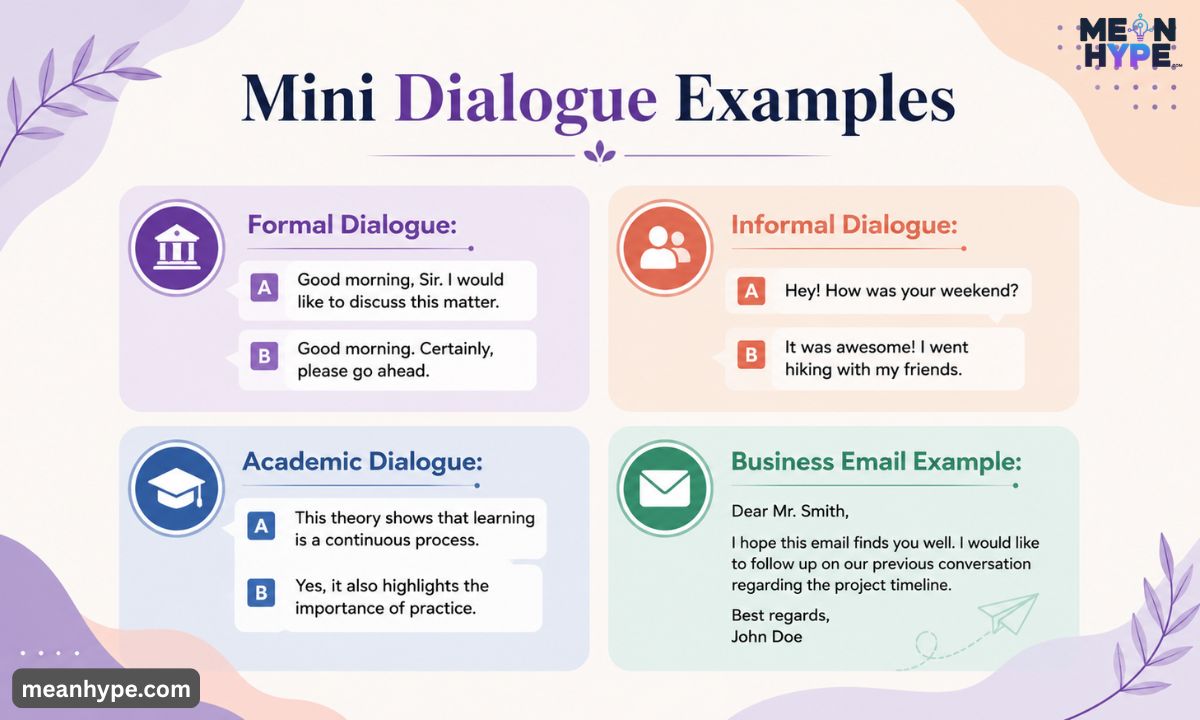
Formal Dialogue:
- A: “The report shows a decline in profits.”
B: “Yes, this demonstrates the need for a revised marketing strategy and improved cost control.” - A: “The analysis indicates a shift in customer behavior.”
B: “That confirms our decision to update the product design.” - A: “The data reveals a significant performance gap.”
B: “Indeed, it highlights areas that require immediate attention.”
Informal Dialogue:
- A: “Wow, the turnout is huge!”
B: “Yeah, this really points out how popular the event is!” - A: “Look at these results!”
B: “It makes clear that we need to work harder next time.” - A: “This project went really well.”
B: “True! It totally shows how teamwork matters.” 😊
Academic Dialogue:
- A: “The findings show a strong link between study time and performance.”
B: “Yes, this illustrates the importance of consistent learning habits.” - A: “The experiment shows unexpected results.”
B: “It actually reveals a deeper pattern we didn’t notice before.”
These dialogues show practical other ways to say this shows in an essay.
Business Email Example:
- Subject: Quarterly Performance Review
Dear Team,
The latest survey results highlight a steady improvement in customer satisfaction over the last quarter. This demonstrates the effectiveness of our recent service upgrades and signals a positive direction for future growth.
Additionally, the data confirms that our new support system has reduced response times significantly. These findings make clear that continued investment in customer experience will be essential moving forward.
Best regards,
Maria
Mistakes to Avoid
When using alternatives to “this shows,” many writers make small but important mistakes that reduce clarity and professionalism.
- Repeating “this shows” too frequently in essays makes writing sound repetitive and basic.
- Using “proves” when the evidence is not strong enough makes arguments sound unrealistic.
- Using informal phrases like “points out” in academic essays where a formal tone is required.
- Overusing advanced words such as “demonstrates” in casual messages can sound unnatural.
- Mixing tones in the same paragraph (formal + informal), which reduces writing quality.
- Using “suggests” and “confirms” incorrectly, where one shows possibility, and the other shows certainty.
- Placing phrases awkwardly in sentences makes the meaning unclear or confusing.
Cultural & Tone Tips
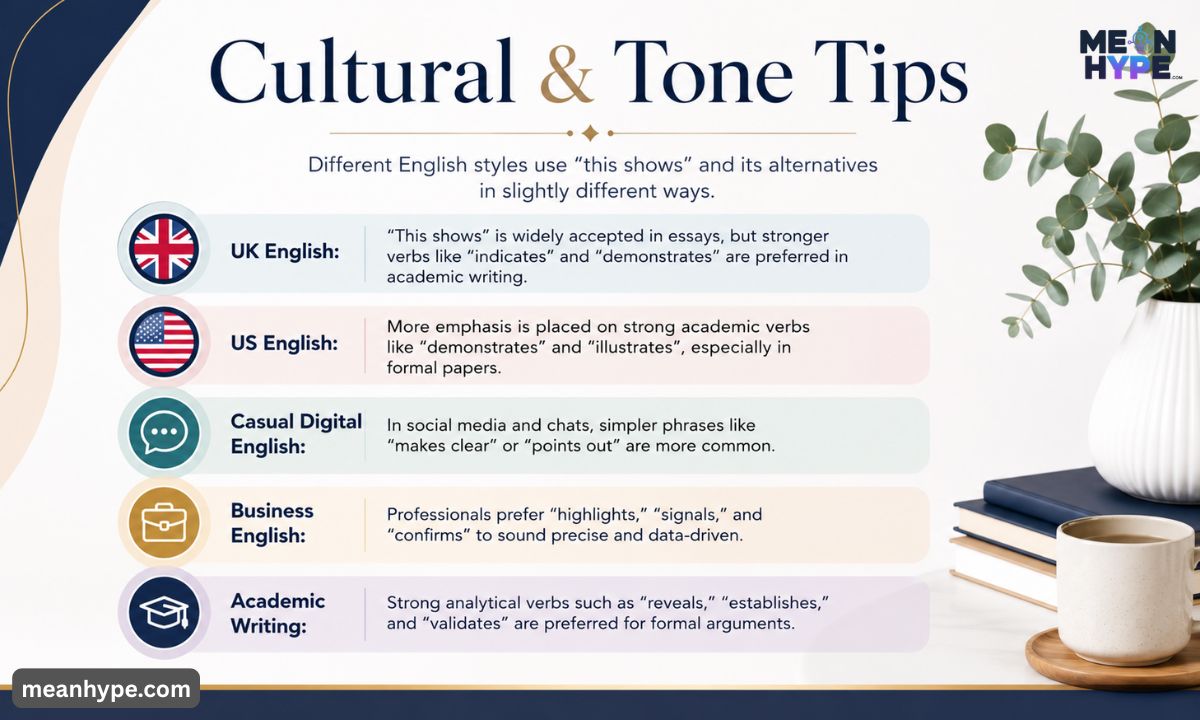
Different English styles use “this shows” and its alternatives in slightly different ways.
- 🇬🇧 UK English: “This shows” is widely accepted in essays, but stronger verbs like “indicates” and “demonstrates” are preferred in academic writing.
- 🇺🇸 US English: More emphasis is placed on strong academic verbs like “demonstrates” and “illustrates”, especially in formal papers.
- 📱 Casual Digital English: In social media and chats, simpler phrases like “makes clear” or “points out” are more common.
- 💼 Business English: Professionals prefer “highlights,” “signals,” and “confirms” to sound precise and data-driven.
- 📚 Academic Writing: Strong analytical verbs such as “reveals,” “establishes,” and “validates” are preferred for formal arguments.
Understanding these differences helps you choose the right expression based on context and audience.
Comparison Table: 5 Best Alternatives
| Phrase | Tone | Best Context | Professional Level | Example |
| Demonstrates | Formal | Academic/Reports | High | The study demonstrates the impact of education on income levels. |
| Highlights | Neutral | Emails/Presentations | Medium | The report highlights key customer concerns. |
| Reveals | Formal | Research/Essays | High | The experiment reveals a new behavioral pattern. |
| Points Out | Friendly | Teaching/Casual | Low | The teacher points out common grammar mistakes. |
| Illustrates | Formal | Academic/Business | High | The graph illustrates long-term sales growth. |
FAQs
Is “this shows” rude?
No, it is neutral and widely acceptable in both spoken and written English.
Can I use “this shows” in essays?
Yes, but using alternatives improves academic quality and vocabulary range.
What is the most formal alternative?
“Demonstrates,” “illustrates,” and “validates” are the most formal options.
What is the easiest alternative for beginners?
“Indicates,” “makes clear,” and “points out.”
Why should I use alternatives?
To improve writing clarity, avoid repetition, and make your essays sound more professional and polished
Conclusion
Learning how to replace “this shows” with stronger academic and professional expressions significantly improves your writing quality. Whether you are writing essays, reports, emails, or presentations, using varied alternatives helps you sound more confident, precise, and fluent in English.
By practicing these expressions regularly, you will naturally improve your vocabulary and develop a more advanced writing style that fits academic, business, and everyday communication contexts 😊

Ston is the founder and author of MeanHype, a website dedicated to explaining meanings, definitions, slang terms, phrases, abbreviations, and modern internet language in a simple and easy-to-understand way. With a passion for language and digital culture, Ston creates helpful content that makes complex or trending terms clear for readers around the world.